
"Your stats are above average."
The doctor at the Spanish clinic sounded calm and reassuring. He told me they still saw pregnancies at my age. He explained the basics of the process. He made it feel possible.
I was 3 months off turning 43. My Anti-Müllerian Hormone (AMH) suggested Diminished Ovarian Reserve (DOR). I had no children, no partner, and no real understanding of what fertility treatment actually involved beyond the broad cultural narrative of "try IVF".
What I didn't understand at the time was that this wasn't simply a medical conversation. It was also a commercial one. I wasn't chatting with my GP (in the UK, we have the NHS.) This was a doctor who I would later pay 8,500 euros.
The doctor didn't seem malicious. Nor does it mean fertility clinics are inherently unethical. But private fertility treatment is a business, and businesses are designed to move customers forward. Then came the bombshell:
"You should get started soon because of your age."
I felt panic rising, compounding the stress of discovering I had DOR. My head whirled as I tried to understand the IVF treatment process. The doctor gave me a brief summary but it was all so alien to me.
Then I made comments about my health that in retrospect were unnecessary. But I completely misunderstood the context of the conversation. I thought I was being assessed. I thought I needed to present myself as a good candidate for treatment. I thought there was a chance they might decide I was too old, or that my ovarian reserve was too low, or that I wasn't an appropriate patient for IVF.
What I didn't understand at the time was that I was speaking to a private clinic. I wasn't sitting an interview. I was sitting in a sales consultation. It never crossed my mind that, regardless of outcome probabilities, there would still be a business incentive to proceed.
The problem is that there is very little standing between a frightened woman under time pressure and spending thousands before she fully understands the landscape she's entering. It's even harder if she's doing it alone.
Why Starting IVF Over 40 Felt So Overwhelming
Looking back, what strikes me most is how little support existed before treatment began.
My first real conversation about my fertility future wasn't with an impartial advisor, or a fertility educator, or even another woman who'd already been through it. It was with the clinic I was considering paying.
That now feels extraordinary to me. If you were buying a house, you might speak with a mortgage advisor before committing financially. If you were planning a major legal or financial decision, you'd likely seek independent guidance before signing contracts.
Yet women routinely enter fertility treatment after one or two highly emotional conversations with people operating inside a private medical system. And because fertility treatment is wrapped in urgency for women over 40, many of us don't realise how vulnerable we are when we enter it.
Why Solo Women Over 40 Are Especially Vulnerable To Fertility Clinic Pressure
As I approached 43, I felt the clock acutely.
After that first consultation, I started Googling. Every article about fertility after 40 reinforced the same message: don't waste time. So when the clinic was ready to move quickly, I moved quickly too. Nobody suggested slowing down. Nobody asked whether I understood the emotional implications of treatment, or whether I'd researched donor eggs, or whether I knew how to evaluate a clinic properly, or whether I even understood the language being used around embryo grading, protocols, supplements, add-ons, and PGT-A (a genetic test).
I didn't know what I didn't know. And I certainly didn't know which questions to ask.
The IVF Information Gap Nobody Talks About
The fertility industry is very good at moving women forward. It is considerably less good at making sure they're properly informed before they begin.
That gap matters.
Because fertility treatment isn't just physically demanding. It's financially draining and medically complex. Two doctors can look at the same test results and suggest entirely different approaches. Some clinics are excellent communicators. Others leave patients scrambling for clarity after they've already paid deposits. Some doctors are thoughtful and nuanced. Others move far too quickly toward donor eggs for women over 40 without properly exploring how that woman feels about the option.
And when you're solo, there's no partner sitting beside you helping to process decisions after consultations end. You are the researcher, decision-maker, financier, emotional support system, and project manager all at once.
That's a huge burden to carry when you're also confronting the possibility that time may be running out. No wonder I've heard many women echo my own thoughts — that planning fertility treatment feels like taking on a second job. And that's before you even start any treatment.
What Solo Women Over 40 Actually Need Before Starting IVF
What I needed back then wasn't reassurance. It was orientation. I needed someone to explain:
- how the fertility industry actually works
- what clinics don't volunteer upfront
- why protocols vary so much
- how to prepare emotionally and financially
- priority questions for fertility consultations
- why rushing into treatment isn't always the wisest move
- and how to stay grounded while navigating one of the most vulnerable periods of your life
Instead, I found myself Googling acronyms and trying to educate myself inside Facebook groups and fertility forums. And I kept coming back to this thought:
"It shouldn't be this hard to get properly informed before making one of the biggest investments of your life."
Why I Created Solo Fertility 40s
That's one of the reasons I started writing publicly about my experiences.
Initially, writing helped me process my difficult experience at the clinic in Spain. Aside from a difficult outcome, there had been a catalogue of errors that started before I'd even paid. I'd also encountered a lack of empathy and the doctor's highly insensitive behaviour.
But the more I wrote, the more women who contacted me from around the world in my DMs to share their own experiences with fertility clinics. Different countries. Different clinics. Different doctors. Yet the same themes kept appearing.
They felt rushed. Under-informed. Dismissed. Emotionally unsupported. Unsure whether the treatment being suggested was genuinely right for them.
The pattern became impossible to ignore.
The Missing Piece Before IVF Begins
And that's why I created the 5-Step Solo Fertility Roadmap.
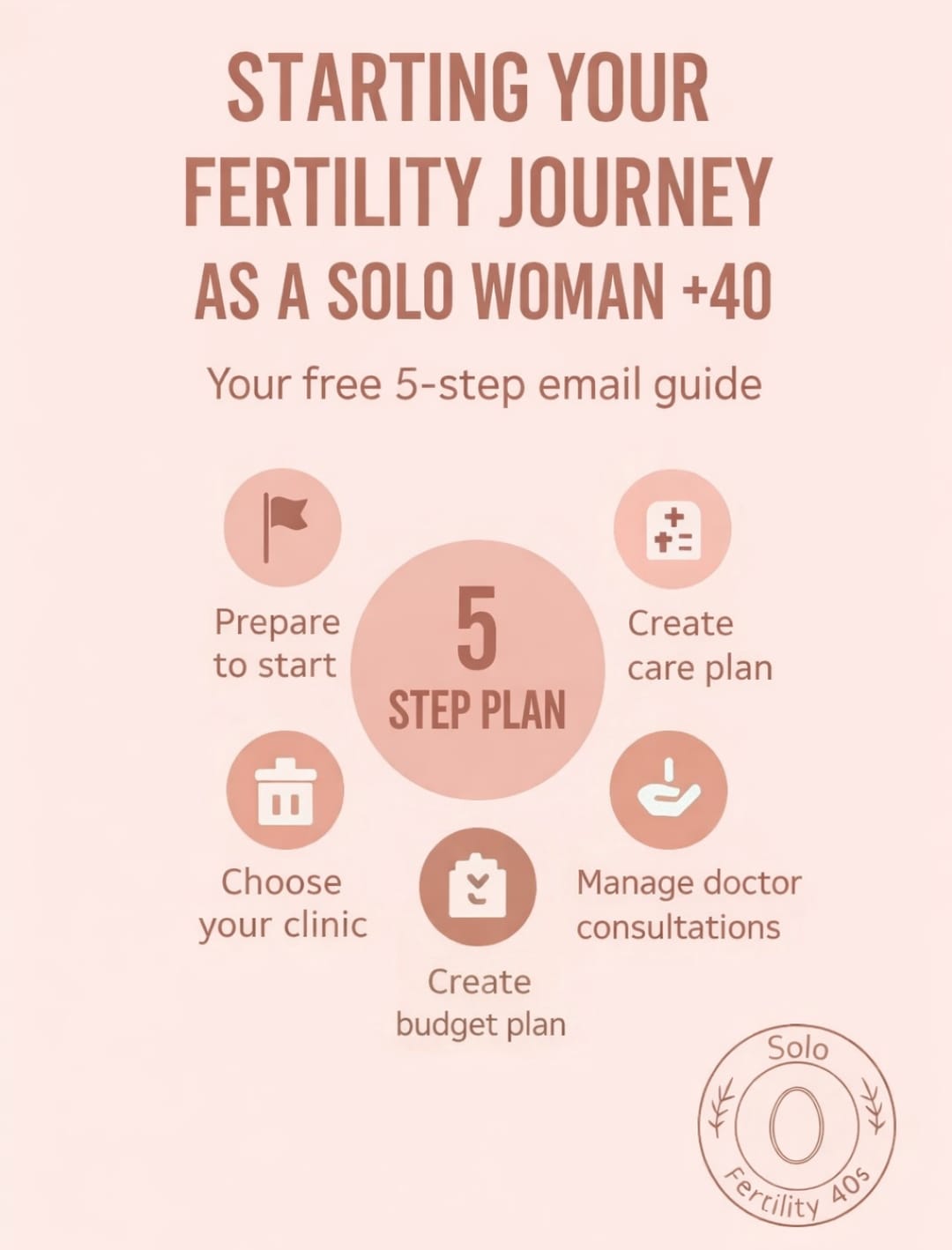
It's not medical advice — I'm not a doctor. I created it because there should be something before the consultation, designed for solo women over 40 standing at the very beginning of this process, wondering where to even start.
The Roadmap is the resource I wish I'd had before I ever booked a consultation. It's designed to help you enter this world informed, prepared, emotionally steadier, and far less likely to hand over your cash without understanding the road ahead.
Because a paid-for consultation should not be the beginning of your education.
Related read
11 tough lessons from my first IVF cycle →Get the 5-Step Solo Fertility Roadmap
Created specifically for solo women over 40 navigating fertility treatment for the first time. The resource I wish I'd had before I ever booked a consultation.
Get the 5-Step Roadmap